Workshop: The city below the city-archaeological and geophysical data to meet a major heritage management challenge

The UMR Archéorient (CNRS, University of Lyon 2), in collaboration with the PROSPECT International Thematic Network are excited to announce the upcoming scientific Workshop on Archaeological Prospection in Urban Environments, scheduled for April 3-4, 2024.

Focused on the interdisciplinary fields of archaeological prospection and heritage management in urban settings, this event promises to be an enriching and informative experience for researchers in archaeology and geophysics, urban archaeological heritage managers and archaeological prospection practitioners alike.

Event details

Dates

3-4 April 2024

Format

Hybrid: Live workshop with webcast

Target audience

  • archaeological and geophysical researchers
  • urban heritage managers
  • archaeological prospection practioners

Registration

via https://event.ugent.be/registration/citybelowcity

Program

Wednesday 3rd April 2024

9:00 Welcome coffee and reception of the participants
9:30 Workshop Introduction

Session 1: Archaeological Prospection and Data Management in Urban Environments

9:45 M.-L. Bassi (Directrice du patrimoine historique, UMR 6298 Artehis), Thomas Chenal (UMR 6298 Artehis) Besançon, a case of archaeological data management by its preventive archeology service
10:15 P. Belford (Heritage Innovation) Urban archaeology, data management and public heritage. some UK perspectives
10:45 Coffee break
11:15 J. Bouwmeester (Cultural Heritage Agency of the Netherlands) Modelling urban archaeology. Mapping expectations and disturbances in urban context in the Netherlands.
11:45 E. Hofmann, H. Tronchère-Cottet, E. Leroy (Service Archéologique de la Ville de Lyon) ALyAS (Archéologie Lyonnaise et Analyse Spatiale), a GIS for managing (geo)archaeological data for the city of Lyon.
12:15 M. Serlorenzi, A. D’Andrea, R. Montalbano, C. Rosa, P. Rosati, D. Sepio (Soprintendenza Speciale Archeologia) SITAR: a new approach for geomorphological reconstruction of ancient Rome through massive geoarchaeological data assessment
12:45-14:00 Lunch Break


Session 2: Case Studies of Archaeological Prospection using Geophysical Approaches in Urban Environments

14:00 D. de Ruijsscher, W. De Clercq (Ghent University) Combining geophysical data, invasive methods and archival research in reconstructing historic town topography. Some case-studies in the Belgian Zwin region (Belgium, The Netherlands)
14:30 J. Creighton (University of Reading), L. Verdonck (University of Cambridge), M. Milett (University of Cambridge) Reconstructing Roman York beneath the streets: legacy data and first GPR prospection results
15:00 B. Fores, G. Hulin et F.-X. Simon(INRAP) Urban Archaeological Prospection in Preventive Archaeology: Lessons and Prospects from Case Studies at INRAP
15.30 Coffee break
16:00 S. Kay (British School of Rome), S. Piro (Institute of Heritage Science-CNR), G. Morelli (Geostudi Astier), E. Pomar (British School of Rome) Urban investigations in the heart of the empire: Archaeological prospection in the Rome Transformed Project
16:30 M. Dabas (CNRS, AOROC), A. Tabbagh (Sorbonne université, METIS), S. Flageul (Sorbonne université, METIS), C. Schamper (Sorbonne université, METIS) Electrostatic surveys for archaeological prospection in urban environments: a review of 30 years of case studies
17:00-17:45 General Discussion

Thursday 4th April 2024

Session 3: Innovations in Geophysical Prospection of Urban Environments

9:00 S. Flageul (Sorbonne université, METIS), C. Schamper (Sorbonne université, METIS), M. Dabas (CNRS, AOROC), A. Tabbagh (Sorbonne université, METIS) Electrostatic surveys: principles and latest developments
9:30 L. Verdonck (University of Cambridge), J. Creighton (University of Reading), M. Millett (University of Cambridge) Recent trends and innovations in ground penetrating radar survey for urban environments
10:00 N. Papadopoulos, D. Oikonmou (Institute for Mediterranean Studies) Advancements and Innovations of electrical resistivity tomography in urbanized environments
10:30 Coffee Break
11:00 D. Boddice (University of Birmingham) Introducing cold atom gravity gradiometry: modelling its potential for urban archaeological prospection
11:30 T. Avgitas (IN2P3), C. Benech (CNRS, Archéorient), L. Brissaud, J.-C. Ianigro (IN2P3), Jacques Marteau (IN2P3), Benoit Tauzin (UCB LYON1) The novel use of muons for subsurface investigations
12:00 L. Bodet (Sorbonne Université, METIS), Q. Vitale(Éveha International, Archeorient)J. Cunha Teixeira (Sorbonne Université, METIS), A. Burzawa (Sorbonne Université, METIS), J. Thiesson (Sorbonne Université, METIS), M. Fondrillon (Service archéologique de Bourges Plus, CITERES), C. Benech (CNRS, Archéorient)
Surface wave seismics in urban prospection: seeking robust results in noisy environments
12:30 B. Tauzin (Université Lyon 1, LGL-TPE), J. Rodet (Université Lyon 1, LGL-TPE), S. Durand (Université Lyon 1, LGL-TPE), J. Marteau (Université Lyon 1, IN2P3), T. Avgitas (Université Lyon 1, IN2P3) Seismic survey with optic fiber: potential benefits in urban prospection
13:00-14:00 Lunch Break


In-person practical training workshop: Ground Penetrating Radar (GPR) data processing

14:30-18:00 T. Wunderlich (Kiel University) This (in-person) training workshop will demonstrate and teach the use of MultichannelGPR – A New MATLAB-Tool for the Processing of GPR Data.

Further info on the software in this publication. The code can be downloaded from GitHub here.

Basic knowledge of GPR data processing is advised.

While a Matlab installation is required on your personal computer (free trial here), no Matlab programming knowledge is necessary for this workshop.

Please note that registration is for this in-person training session on a first-registered, first-served basis, as spaces are limited to 25.

We encourage prompt registration to secure your spot.

For those attending the workshop in person but unable to secure a spot in the training session, there will be an opportunity for a guided site visit (no registration required).

Further information

Venue

Museum and archaeological site of Saint-Romain-en-Gal (Vienne, France)

 Location

Email

prospect@ugent.be

Webpage

https://www.prospect.ugent.be/workshop-city-below-the-city/

Organized by

 

Supported by


Geoarchaeological reconstruction of Holocene coastal landscapes along the North Sea

Introduction

The PROSPECT international thematic network, the High Tide – Low Tide CRA at Ghent University and the Bruges archaeological service RAAKVLAK are hosting an international workshop on the ‘Geoarchaeological reconstruction of Holocene coastal landscapes along the North Sea’ at the Groeningemuseum in Bruges, Belgium.

The event kicks off on 16/01/2023 with a welcome reception and guided tour of the exhibition and AR table Bruges and the sea in Bruges’ City Hall. On 17/01/2023, a wide range of presentations will address innovative approaches for reconstructing (pre)historic coastal peat and tidal landscapes. During the last day of this workshop (18/01/2023), we organize practical training sessions during which we will share state-of-the-art practices in coring, describing, sampling and interpreting Holocene coastal sediment sequences.

The workshop qualifies as verdiepende opleiding voor erkende archeologen. Please, provide your recognition number during registration if you’re an archaeologist recognized by the Flemish heritage agency.

Registration

The number of participants is limited.

To register, please purchase your tickets before 11 January.

Please mention any dietary requirements and/or erkenningsnummer in the remarks field during checkout.

Fee

Entire workshop: €100

Tuesday 17/01/2023: €50 (max. 60 participants)

Wednesday 18/01/2023: €50 (max. 40 participants)

Students pay half price (€25/50 – bring your student card for verification)

Preliminary programme:

Monday 16/01/2023

Opening reception and guided visit to the exhibition and AR table Bruges and the sea

Location: City Hall – Gothic Hall (Burg 12, Bruges)

Time: 17h-20h

Tuesday 17/01/2023

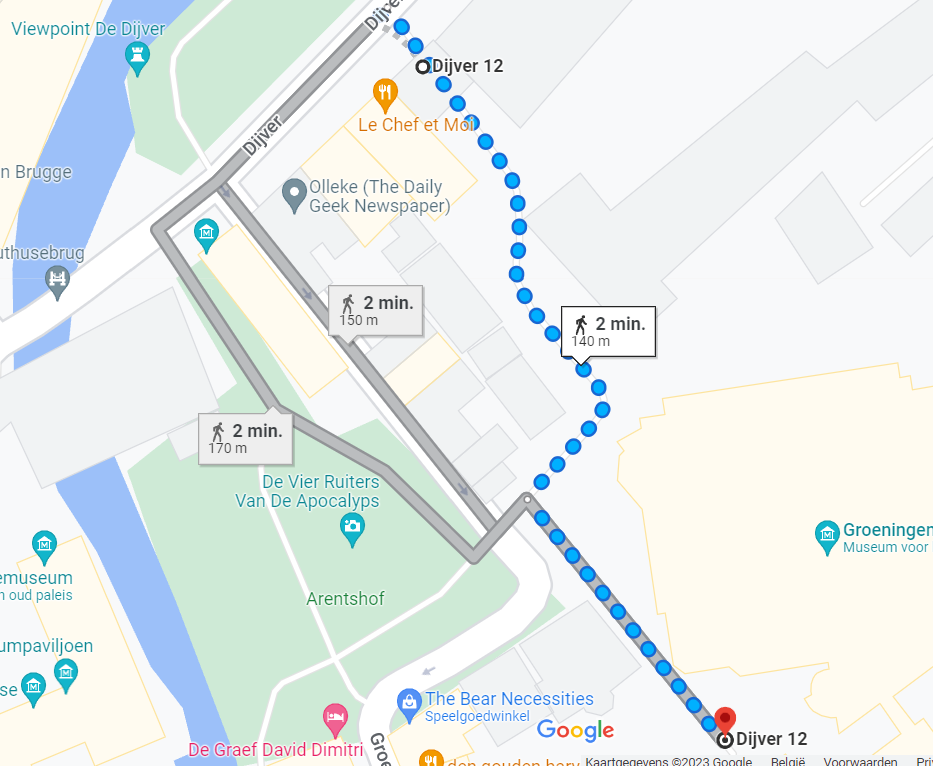
Location: Groeningemuseum – Vriendenzaal (Dijver 12, Bruges) (Location)

Routes from Dijver 12

08.30-09.00 Registration and welcome
09.00-09.30 Peter Vos Keynote: Paleolandscape and geoarchaeology of the Holocene coastal plain with particular focus on Zeeland (NL)
09.35-09.55 Annelies Storme et al. Peat as a window to the past: Synthesis of research into peat landscapes in the Eastern Belgian coastal plain
10.00-10.20 Frieda Bogemans et al. Unravelling the Late Holocene sedimentary evolution and the medieval waterfront in the Zwin-harbour at Hoeke
10.25-10.45 Coralie André & Dante de Ruijsscher The reconstruction of the palaeoenvironment at Aardenburg during the Roman period using pollen and diatoms
10.50-11.20 Coffee break
11.20-11.40 Harm Jan Pierik Peat as a driver of coastal change: the evolution of the Old Rhine estuary
11.45-12.05 Kay Koster 3D modelling of Holocene peat in the Netherlands: applications in archaeology and beyond
12.10-12.35 Jan Trachet Exhibition introduction: Pieter Pourbus. Master of Maps
12.40-14.00 Lunch break with visit to the exhibition Pieter Pourbus – Master of Maps
14.00-14.30 Annet Nieuwhof et al. Keynote: A miserable people? Human habitation in the coastal salt marsh landscape of the northern Netherlands from 600 BC.
14.35-14.55 Roy Van Beek, Cindy Quik & Marjolein van der Linden Drowning landscapes revisited. Correlating peatland expansion, human habitation trends and vegetation dynamics in the Northwest European mainland
15.00-15.20 Svea Mahlstedt, Martina Karle & Annette Siegmüller Mesolithic landscape prospection in Northwest Germany
15.25-15.45 Dennis Wilken, Bente Sven Majchczack & Wolfgang Rabbel Geophysical and geoarchaeological prospection in North Frisia’s tidal flats
15.50-16.10 Samuel Desoutter, Mathieu Lançon et al. The reclamation process of the Denna tidal channel: First results of 900 hectares led-archaeology survey around Dunkirk (France)
16.15-16.45 Coffee break
16.45-17.05 Soetkin Vervust et al. Searching for the lost peninsula of Testerep: how integrated land-sea research is uncovering the evolution of the Belgian Middle Coast (5000 BP -present)
17.10-17.30 Immo Trinks High-resolution underwater archaeological prospection using sonar measurements
17.35-18.00 Plenary discussion and closing remarks

Wednesday 18/01/2023

Location: Groeningemuseum – Vriendenzaal (Dijver 12, Bruges)(Location)

Routes from Dijver 12

WEAVE meeting at City Hall – Collegezaal (Burg 12, Bruges)

Training session webpage

09.30-10.00 Jari Mikkelsen, Frieda Bogemans, Annelies Storme, Luc Allemeersch & Coralie André An introduction to sediment and soil description, paleo-ecological sampling and macroscopic peat description
10.00-13.30 Frieda Bogemans, Annelies Storme, Jari Mikkelsen, Luc Allemeersch & Geosonda Environment n.v. Practical workshop in small groups: demonstration mechanical coring, pedological & sedimentological core description, macroscopic peat analysis, paleo-ecological and radiocarbon sampling
13.30-15.00 Participants Group assignment: pedological & sedimentological core description, macroscopic peat analysis, paleo-ecological and radiocarbon sampling of a coastal or estuarine sequence
15.00-16.00 Participants Short presentations of group assignment results

Further info & contact

PROSPECT@UGent.be

Organizers

VIRTUAL SAGA WORKSHOP ON GEOPHYSICS & ARCHAEOLOGY (16/11/2021) AND ARCHAEOLOGICAL MONITORING (17/11/2021)

Ghent University and the Flemish Heritage Agency organize a virtual workshop on geophysics in archaeology & archaeological monitoring in collaboration with COST Action SAGA (CA17131).

Format

-Prerecorded 20 min presentation videos to be watched before the workshop. These videos will be available via a password protected web-page.

-Lightning talks+Q&A via MS TEAMS in the mornings (10h-12h CET) of the workshop days.

-Roundtable discussion VIA MS TEAMS using Whiteboard in the afternoons of the workshop days (13h-15h CET).

Participation

If registered, the workshop content is available through this password protected participation page.

Program & presentation topics

16/11/2021: Geophysics in archaeology

10h-12h (CET): Lightning talks of recorded videos+Q&A

De Smedt Philippe UGENT Which types of information can geophysics provide for archaeologists-a practical perspective.

Watch the recording.

Nguyen Frédéric ULIEGE Can I fully trust the colored images that geophysicists give me?
Blanchy Guillaume ILVO The rise of geophysics for agricultural applications: what, why and for whom?

Watch the recording.

Anderson Stamnes Arne NTNU Geophysical methods in archaeology: situation, trends, applications and challenges in Scandinavian archaeological resource management.

Watch the recording.

Simon François-Xavier INRAP Geophysical methods in preventive archaeology: Consequences of archaeological feedback on the current practices at Inrap.

Watch the recording.

Trinks Immo UVIENNA Future perspectives on archaeological geophysics.

Watch the recording.


13h-15h (CET):Parallel roundtable discussions

Roundtable discussion 1: Geophysical methods in (development-led) archaeological resource management.

This roundtable is coordinated by the PROSPECT international thematic network (moderated by J. Verhegge)

Contrary to archaeological research in academic contexts, where geophysical methods are well-established and widely applied, the extent of the application in development-led archaeological resource management strategies differs strongly internationally. In fact, most development-led archaeological evaluation studies continue to rely primarily on invasive archaeological prospection methods (e.g. trial trenching, test pitting, core- or auger sampling) to detect, identify and evaluate archaeological remains.

This discussion groups aims to address following issues:

-How does the application of geophysical methods differ in development-led archaeology internationally? Is this difference related to differing archaeological resource management systems (commercial, governmental, academic,…), the environmental context (soils, geology, landuse, …), research traditions, recent developments, …?

-Are geophysical methods over- or under-applied in these different archaeological evaluation contexts? What are the ensuing risks and opportunities for archaeological heritage management?

-How do we deal with uncertainty of geophysical results and archaeological interpretations in development-led site evaluations?

-Which strategies are suitable for combining both geophysical and/or invasive archaeological prospection methods in (development-led) archaeological prospection?

Roundtable discussion 2: Geophysical methods in archaeological prospection and precision agriculture

This session is coordinated by the IPAAST project (moderated by P. De Smedt)

Since the 2000s, growing concerns over environmental impacts of agriculture and advances in geospatial technologies have led to the emergence of Precision Agriculture (PA), which is positioned to fundamentally change the way in which rural landscapes are managed. Precision agriculture shares several survey technologies with those used in archaeogeophysical survey.

The data resulting from surveys and monitoring in PA have varying spatial and temporal scales and provide opportunities and challenges for archaeological use. First, even if much of the collected PA data is potentially of archaeological interest, it is significantly different from current archaeological prospection data. Therefore, it requires new analytical and interpretative approaches. Second, developing data sharing schemes with PA practitioners invites archaeologists to develop new relationships and to promote a positive shared agenda, but doing so involves significant social and policy challenges.

In this roundtable discussion we will discuss:

-How changing agricultural practices, particularly precision agriculture, enables and constrains archaeological prospection.

-How might changes in agricultural practices influence the character and legibility of archaeologically relevant proxies?

-How we might adapt our archaeological survey practices in response to significant changes in rural land management, new and emergent agricultural practices, technological advances, and increasing emphasis on providing public benefits and taking action to address challenges around environment, climate and sustainability of rural communities.

-What opportunities are presented by changing policies and attitudes around agriculture, natural conservation, and rural communities to develop mutually advantageous connections between archaeological and agricultural communities, based on shared interests in the past and contemporary character of farmed landscapes?

17/11/2021: Archaeological Monitoring

10h-12h (CET): Lightning talks of recorded videos+Q&A

Meylemans Erwin OE Introduction to archaeological site monitoring.

Watch the recording.

Goeminne Nele OE
Gaffney Christopher UBRADFORD Geophysical monitoring in archaeology: the contribution of the DART (Detection of Archaeological Residues using remote sensing Techniques) project.
Boddice Dan UBIRMINGHAM
Ngan-Tillard Dominique TUDELFT Monitoring megalithic monuments through geophysical methods.

Mechanical loading of construction works endangers the Dutch buried archaeology. Yes or no?

Schneidhofer Petra Vestfold & Telemark County Council Geophysical monitoring in archaeology: The Borre and Vestfold Monitoring Projects.

Watch the recording.

Morris Isabel NMT Geophysical methods for studying structural integrity of cultural heritage.

Watch the recording.

13h-15h (CET): Roundtable discussion

Roundtable discussion 3: Geophysical monitoring in archaeology.

This roundtable is coordinated by the SAGA COST action (moderated by E. Meylemans)

Archaeological site monitoring is a fairly recent development in archaeological resource management. Its importance is growing due to the preference for in situ preservation, if possible, in development-led archaeology. In addition, known (scheduled) archaeological sites are also threatened by e.g. modern landuse, agricultural practices, groundwater alterations or coastline adjustments e.g. due to climate change. This requires development of appropriate monitoring strategies.

In this roundtable we will address:

-What do we understand by monitoring in archaeology? E.g.:

A watching brief: Checking construction works on (potential) archaeological sites.

Timelapsed archaeological data collection: Revisiting sites at regular intervals and investigation using current archaeological investigation methods.

Continuous/Cross)temporal monitoring: (in situ) data collection on archaeological sites ((geo)physical or (geo)chemical, field surveying, augering, trenching, …).

-Should warning systems be developed for archaeological site monitoring? What can be take away from other fields?

-What site or soil properties can be monitored using which (geo-)physical and/or (geo)chemical proxies/methods?

-Should we only use (e.g. geophysical) properties that do not vary across time to investigate the influence of temporal changes in geophysical signals of archaeological sites?


Acknowledgements

The organizers would like to acknowledge the contribution of the COST Action SAGA: The Soil Science & Archaeo-Geophysics Alliance – CA17131 (www.saga-cost.eu ), supported by COST (European Cooperation in Science and Technology).